The structure is stable and repeatable across the network.
April is already underway, and the industry is moving into its next phase.
Jetron will be exhibiting at AERO Friedrichshafen, one of the key meeting points for European aviation.
Before stepping into April, it makes sense to look at what March has already revealed.
From above, March 2026 shows a market operating with consistency and clarity.

Private aviation activity in March reached a broad and stable operational level across Europe.
60,901 arrivals were recorded across 1,255 active airports, with 4,678 aircraft active in the network. A total of 26,229 unique airport pairs reflects a dense and highly connected system.
Operational volume and network depth are aligned.
The core hubs remain stable, with Paris Le Bourget, Geneva, Milan Linate, Farnborough, and Nice continuing to generate high-frequency traffic.
Beyond these, several secondary airports show strong activity patterns.

Airports such as Sion, Lugano, and Cannes Mandelieu demonstrate concentrated regional demand, especially linked to alpine and leisure-driven flows.
Oxford and Biggin Hill continue to support business aviation traffic connected to London without relying on primary commercial infrastructure.
At the route level, repetition becomes visible. Certain airport pairs operate with notable frequency, indicating established corridors rather than occasional movement. These patterns reflect routine usage across short- and mid-range distances, typically within 300–800 km.
This range continues to define how private aviation is used across Europe.
Turboprops lead in total arrivals, followed by Light Jets and Super Light Jets.
This distribution aligns closely with the observed route structure and distance profile.
Aircraft are deployed in a way that matches frequency, flexibility, and airport accessibility.
Heavy and Ultra Long-Range aircraft remain present across the network, primarily on longer connections and specific high-demand routes.
Operational activity remains balanced across commercial and non-commercial usage, with fractional structures maintaining a steady share.
Europe accounts for more than 94% of departures. North America, Asia, and other regions appear within the network as extensions connected to specific flows.
The structure of movement remains strongly centered within Europe.
March reflects a network that has settled into its operating pattern.
High-frequency intra-European connections. Consistent aircraft utilization. Clear alignment between distance, aircraft type, and airport choice.
The structure is stable and repeatable across the network.
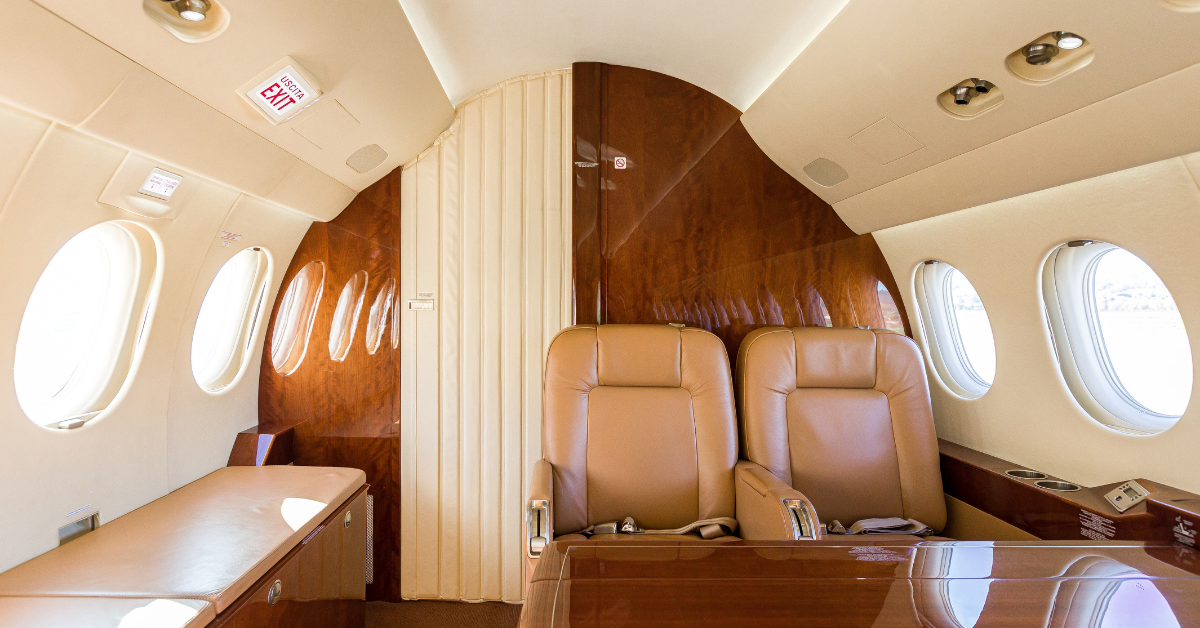
For the second time in this series, the Falcon 7X becomes Aircraft of the Month.
This aircraft continues to show strong relevance across different operational scenarios.
Its range allows intercontinental connections, while its performance supports access to more restricted and demanding airports.

The Falcon 7X fits naturally into a network where flexibility, reach, and airport access all play a role.
Repeated presence in this section reflects consistent performance across the market.
At Jetron, a 2008 Dassault Falcon 7X is currently available for sale, positioned for exactly this kind of operational environment.
More details here.

JETRON has once again closed a transaction involving a large-cabin business jet.
August marked a step down from July’s peak activity
Jaroslav brings more than two decades of experience in the aviation industry





_white.png)